Sign up for Chalkbeat Indiana’s free daily newsletter to keep up with Indianapolis Public Schools, Marion County’s township districts, and statewide education news.
Jonnah Davidson walked into his school’s new cafeteria on Wednesday thoroughly impressed.
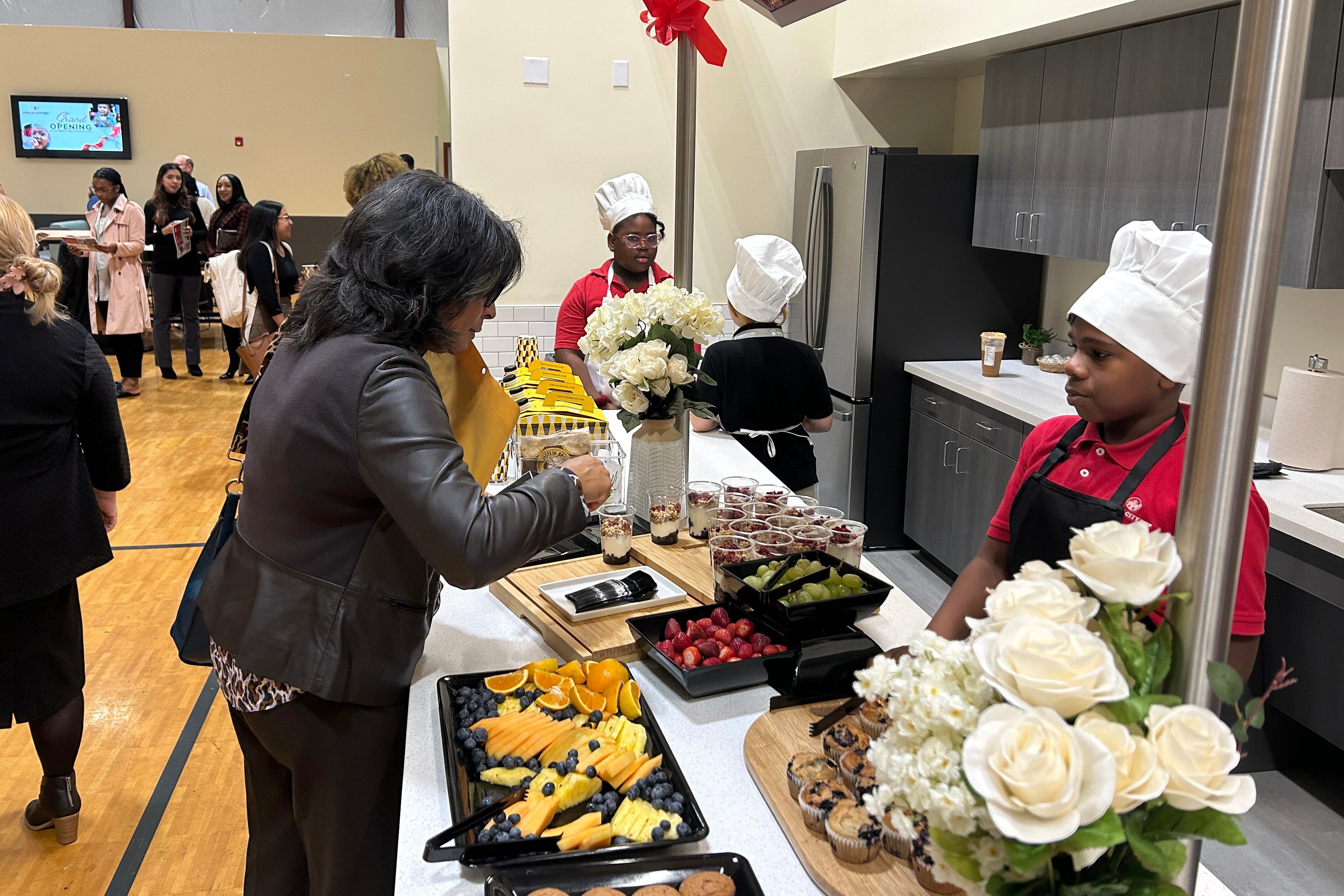
The new Circle City Prep cafeteria — known in school as “C3″ — is part of a $1.5 million investment the school made with the help of philanthropic donors to provide a new scratch kitchen with an on-site chef and a new learning laboratory space for the school’s after-school culinary club.
The project also included an overhaul of what students get to eat for lunch. Last year, the school began to transition from prepackaged, reheated food, like warmed-up pizzas, to fresh produce and meals made at the school. Students can choose fresh kale salads, something from the produce bar, and other options.
It’s a big deal for Circle City Prep, a school on the far east side, where family income levels qualify nearly every student for free or reduced-price lunch and many residents struggle with access to grocery stores and fresh food. The school and its community partners hope the new cafeteria and food lab will not only help students discover new food options, but also be open to the community as it addresses food insecurity as a whole.
The cafeteria space, with its sleek new seating, opened to students for the first time last month. During the construction, students were eating food in classrooms.
“This year, it feels like everything’s just new,” said Davidson, a sixth-grader. “I actually went into the kitchen one time and helped make a pizza. I feel like there’s more options.”
The project drew on assistance from the Patachou Foundation, a local nonprofit that works to address hunger. The group helped ensure the project complied with federal regulations for the National School Lunch Program, which covers the cost of lunch for students from low-income families.
Circle City is one of the foundation’s first “PataSchool” sites, where the group supports a transition from prepackaged meals to fresh food prepared on-site.
“Food insecurity is not just about scarcity. It’s a profound issue of justice,” Matthew Feltrop, executive director of the PataSchool program at the Patachou Foundation, said in remarks at the school celebration on Wednesday. “Merely providing food to prevent starvation perpetuates the cycle of poverty, and the real challenge is to break the cycles through innovative approaches and sustainable strategies.”
At Circle City Prep, the foundation’s in-kind aid includes help with recipes, training for kitchen staff, and help with operating the school cafeteria, Feltrop said.
The foundation is also helping Adelante Schools at Emma Donnan, a charter school in the Indianapolis Public Schools Innovation Network, for the first time this year.
Amelia Pak-Harvey covers Indianapolis and Lawrence Township schools for Chalkbeat Indiana. Contact Amelia at apak-harvey@chalkbeat.org.