Sign up for Chalkbeat’s free weekly newsletter to keep up with how education is changing across the U.S.
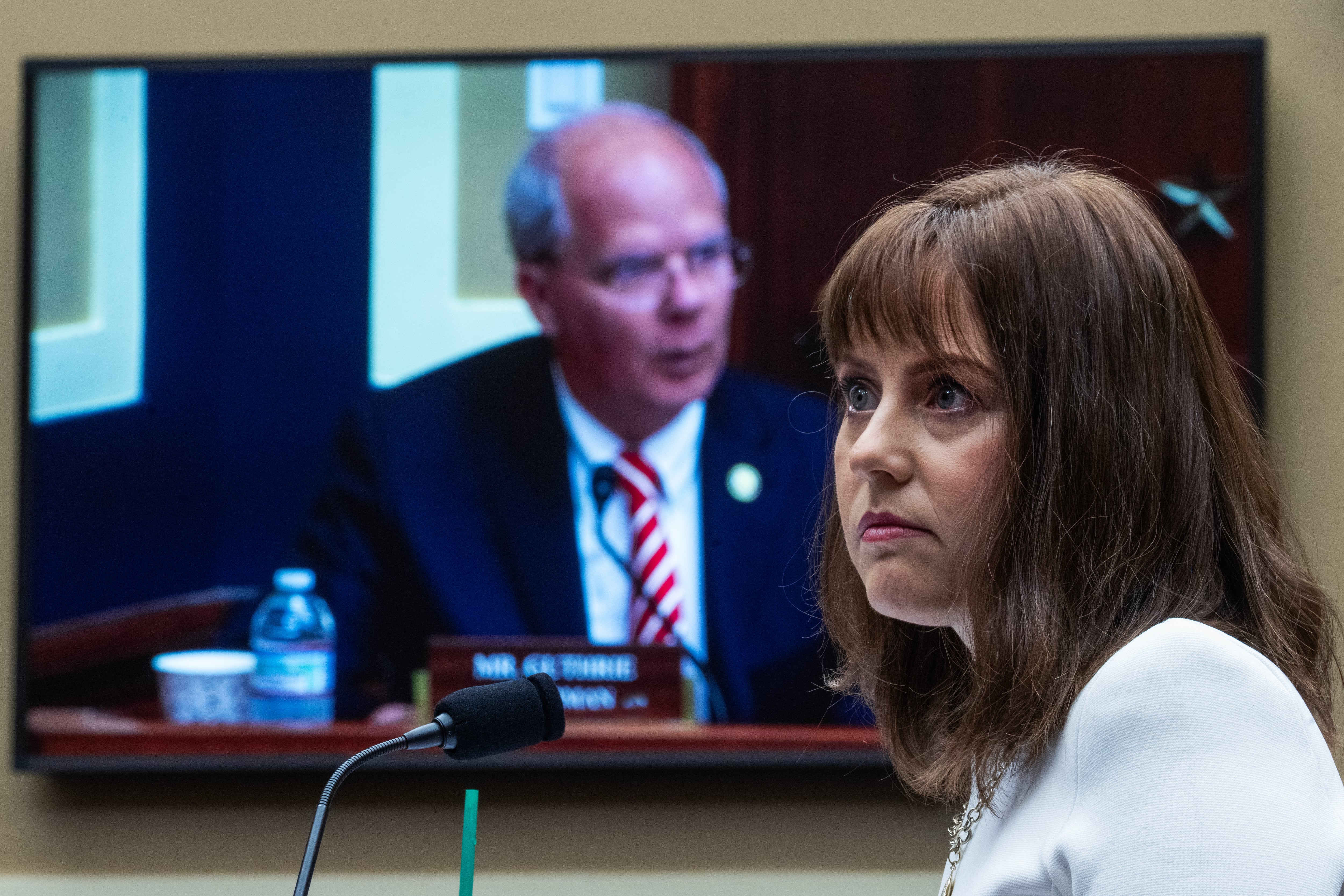
Like many parents, Arielle Roth has concerns about her children’s screen time at school. But unlike her peers, she’s in a position to influence the issue at nearly every school in America.
Roth heads an obscure federal agency within the Commerce Department that serves as the president’s top policy adviser on telecommunications issues. In that role, she’s called for more scrutiny of federal policies that support technology in the classroom, convened listening sessions with screen-skeptic parents, and coordinated between federal agencies. She calls the struggle “deeply personal.”
“It’s hard enough to manage at home,” Roth, a mom of six, said at a luncheon last year with a free-market think tank. “But it’s even harder when screens have become inescapable at school.”
Now the Federal Communications Commission — citing Roth’s work and riding a broader backlash to education technology — is conducting a wide-ranging review of federal school internet subsidies that could lead to their elimination, or new requirements for schools to restrict screen time or allow parents to opt out in order to receive the money.
The changes under consideration could be financially devastating and deeply disruptive to classrooms and daily school operations, district leaders and education advocates say.
Paid for through fees on telephone bills, the roughly $3 billion a year E-Rate program covers between 20% and 90% of schools’ internet expenses. The nearly 30-year-old program is the fifth largest source of federal support for schools, according to an analysis by E-Rate advocates.
FCC Chair Brendan Carr asked whether E-Rate has served its purpose. He said the FCC’s review will consider “educational opportunity,” as well as whether “additional safeguards, refinements, or updates are needed to better protect kids online.”
The review comes even as the White House remains an enthusiastic booster of AI in education and as schools are under conflicting pressures to limit screen time and prepare kids for a job market that depends on artificial intelligence.
In an interview, Roth, administrator of the National Telecommunications and Information Administration, said it’s time to ask “what E-Rate has meaningfully accomplished and how it has affected behavior.”
“Subsidies are not neutral,” she said. “Subsidies can encourage greater consumption. Understanding how the program has changed educational practice is really important.”
But E-Rate first and foremost supports schools’ access to a modern utility, said Noelle Ellerson Ng, chief advocacy and governance officer at the School Superintendents Association.
“Screen time is a curriculum and a content question,” she said. “The FCC is not the body to regulate those things.”
Schools use E-Rate for security, finances, and instruction
When Congress approved E-rate in 1996, just 14% of U.S. schools had internet access. Then-FCC chair Reed Hundt hailed the program as “the biggest single national effort to change education in classrooms K-12 in the history of our country.”
A 2014 overhaul set bandwidth targets and made more money available for WiFi and internal building connections. The hope was that better internet would support more personalized learning — though within five years, school technology directors were warning that schools needed even faster internet to support the expansion of ed tech.
Still, school district leaders say that access really has been transformative.
Thanks to E-Rate, high school students in the Alaska Gateway School District, where many schools can’t be reached by road for most of the school year, can take virtual career-technical courses to prepare for apprenticeships, Superintendent Patrick Mayer said. The internet also allows Indigenous language teachers to tap online Athabaskan language resources.
“Connectivity is very important for us because it is our lifeline to the outside world,” he said.
It’s not just instruction. Schools use the internet for everything from school security and HVAC systems to attendance and payroll.
But has internet access improved student learning? An influential 2006 study found no improvements in California. More recent studies have found mixed results.
Meanwhile, student test scores are at historic lows, and concerns that screens have hurt attention spans and cognition have led schools to bans laptops and YouTube, as well as restrict AI use.
At a listening session Roth’s agency convened this month, parents discussed how dysregulated their children became after hours on tablets, how shallow and rote the learning felt, and how difficult it was to opt out. Their comments will be shared with the FCC, which is accepting public comment on E-Rate through Oct. 13.
“Facilitating screen time is effectively the choice to harm our kids,” said Peter Ryan, a parent activist and co-founder of the Center for Responsible Technology. “To do so is to give them a digital drug.”

That same week, the Education Department hosted a convening called “From Screentime to Screen Value,” put on by an educator group that supports tech in the classroom. The Education Department and the FCC did not respond to questions about its role in the E-Rate review.
Screen time concerns have helped conservatives revive longstanding critiques of E-Rate and other federal affordable-internet programs.
Among the more vocal critics is U.S. Sen. Ted Cruz, a Texas Republican who chairs the Senate Commerce Committee, where Roth previously worked on telecommunications policy. Cruz sponsored legislation that would have conditioned E-Rate on screen-time policies, but it stalled in Congress.
“Good policy occasionally takes the scenic route,” Cruz wrote in a post on the social media site X praising the FCC E-Rate review.
FCC puts parental opt-out policies on the table
The FCC’s E-Rate review sets the stage for commissioners to vote on major changes to the program. Without published draft rules, advocates are left reading between the lines as to what those might be.
The issues that concern school districts the most are the FCC’s views on whether E-Rate should end, whether E-Rate should be limited to rural communities, and whether schools should have to adopt technology limits and opt-out policies to participate.
Ending E-Rate — a possibility the FCC downplayed this summer and which many advocates don’t believe is within the FCC’s authority — would be catastrophic, district leaders said.
E-Rate provides more than $700,000 a year for Alaska Gateway, about 7% of the district’s budget, Mayer said. In larger districts, it can be worth many millions. Because schools can’t go without internet, they’d have to find that money elsewhere in their budgets.
“The school districts that are more affluent would continue to have modern schools, and those that serve less affluent areas would be the ones making the toughest choices,” said LaTonya Goffney, president of the School Superintendents Association and superintendent of the Aldine Independent School District, a high-poverty district in Houston.
But mandatory opt-out policies would also be disruptive, district leaders said, because they would require teachers to develop alternative lesson plans and potentially single out students with disabilities who rely on technology for accommodations.
Parents know what’s best for their own child, Ellerson Ng said, but “superintendents are responsible for every child in their district and all of their diverse needs.”
Roth, though, said robust opt-out provisions could encourage a bigger conversation about school internet use and would be consistent with the Trump administration’s focus on parental rights.
“The same conditions that give parents an escape valve could also serve as a check on the subsidy to make sure school districts aren’t using more than they need,” she said.
But with E-Rate on the line, even some advocates for stricter screen time limits are nervous.
“All of these questions they’re asking about screen time and the education efficacy of technology and family’s input on what happens in schools are the right questions,” said Haley Hinkle, policy counsel at Fairplay, a group that fights the influence of tech in children’s lives. “We’re concerned about tying these questions to the provision of internet.
“In the modern world, schools need internet, and kids need internet.”
Erica Meltzer is Chalkbeat’s national editor based in Colorado. Contact Erica at emeltzer@chalkbeat.org.