

 Opens in new window
This story was reported and published in collaboration with WBEZ, the Chicago Sun-Times, and Block Club Chicago, a nonprofit newsroom covering Chicago’s diverse neighborhoods. Stay informed with Chalkbeat Chicago’s newsletter, WBEZ and the Sun-Times’ education newsletter, and Block Club Chicago’s newsletters.
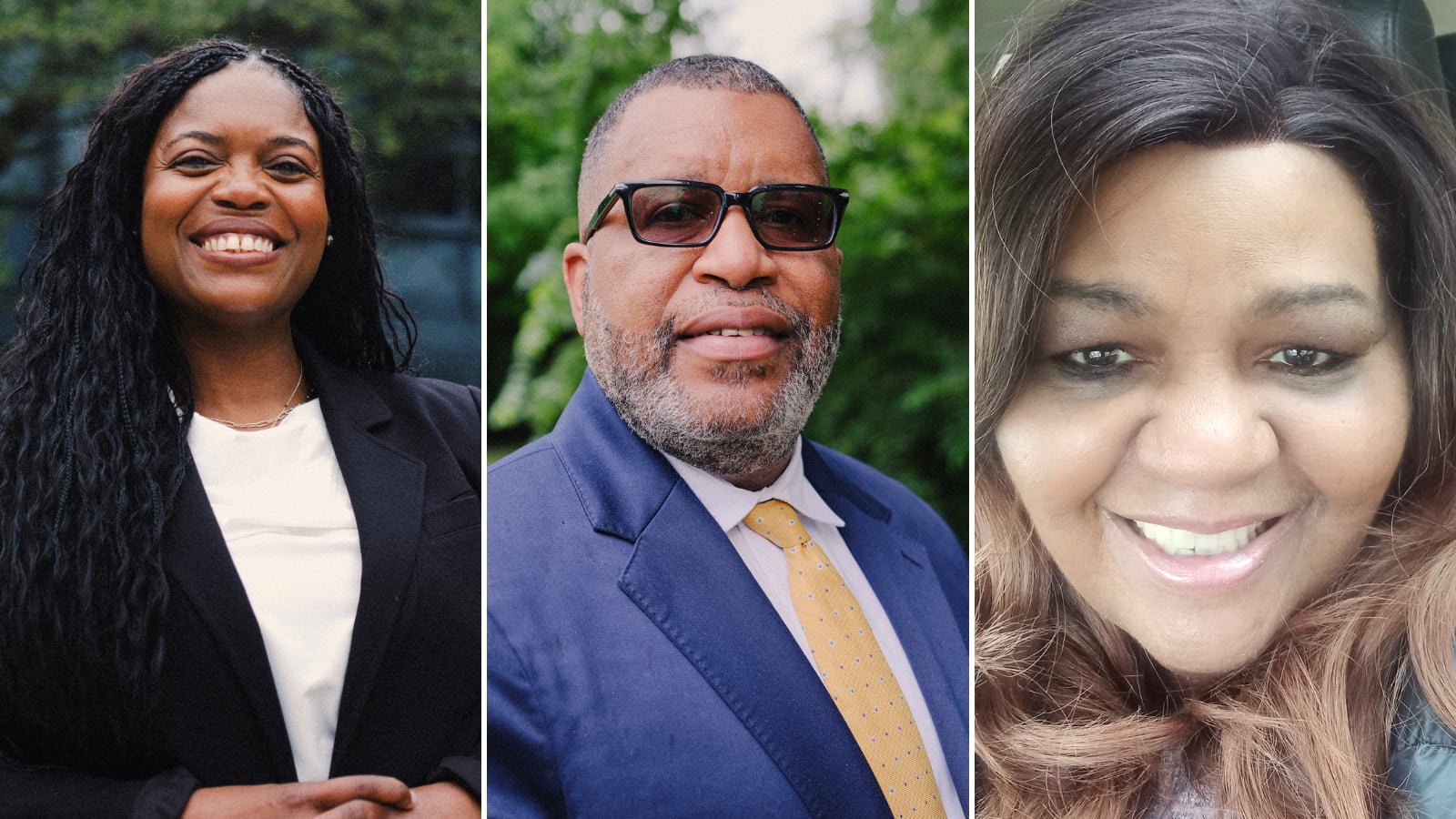
At first glance, the candidates vying to represent Chicago’s Southeast Side seem like two moms and a dad with grown children who went through Chicago Public Schools and now want to make it better for the next generation.
But under the surface are bigger political fights between the mayor and an adversary.
Connie Anderson, a paralegal and mom of twins who attended CPS, got a leg up when Mayor Brandon Johnson appointed her to fill the vacant seat in July after she filed her paperwork to run in May.
Patrick Watson works as the lead legislative aide in the office of 9th Ward Ald. Anthony Beale, one of Johnson’s harshest critics.
Then there’s write-in candidate Rosita Chatonda, a former teacher who spent years challenging her CPS firing that landed her on the district’s “do not hire” list.
District 10b includes Far South Side areas with a long, uneasy relationship with industry. The steel mills that once operated there provided jobs but also polluted the area and, once gone, left many residents without work.
This school board electoral district has the second-most public schools and students. Two-thirds of its students are Black and 31% are Latino.
Watson said Anderson’s recent appointment is “indicative of the games being played.” She has the endorsement of the Chicago Teachers Union, which is closely aligned with the mayor. He is endorsed by the Common Ground Collective, an anti-CTU political action committee that is heavily funded by billionaire Michael Sacks and says it aims to engage voters around “effective progressive policies.”
“I just don’t think politics belongs in education,” Watson said. “I think education belongs in education.”
The three candidates in this race disagree on the Illinois Quantum & Microelectronics Park, the massive research and technology facility being built in their district. Anderson doubts it will have a positive impact on schools, citing pushback over a contractual agreement.
But Chatonda sees possibilities and Watson said it is “an excellent opportunity for CPS.”
“This is the wave of the future, so it’s the perfect time to get in on the ground floor and partner with them to see how we can incorporate this into the curriculum for our students,” he said.
If elected, Anderson’s first priority would be to make sure that special education is fully funded and that students with disabilities get the support they need to thrive.
She’s the mother of twins, one of whom needed special education services. She said she had to battle to make sure her daughter learned alongside her elementary school peers as much as possible, as federal law calls for, instead of in separate classes.
Anderson remembers telling the school it felt like her child, like many others, was “being thrown to the wayside.” After Anderson got an outside evaluation, the elementary school gave her daughter an aide and kept her in traditional classes. She’s now 28 and in a master’s program in architecture.
Another pivotal experience for Anderson was when her daughters went to Ogden International for high school.
At the time, Ogden’s elementary school, located in one of the city’s wealthiest areas on the Near North Side, merged with Jenner Academy, which served mostly low-income Black children, many of whom lived in nearby subsidized housing.
Anderson helped fundraise with Friends of Ogden and fought for funds to go to former Jenner students and high schoolers, two-thirds of whom were low-income and Black or Latino.
She saw how those extra resources allowed for things like a robotics program that put many students on an engineering path. She wants more kids to have those opportunities.
“The ceiling opened for those kids that did not think it was possible,” Anderson said.
Read Anderson’s full questionnaire.
Watson lives in Pullman, not far from the Roseland home where he grew up. He went to the neighborhood elementary school, where “everyone lived close to each other” and “there was camaraderie,” and then attended Chicago Vocational Career Academy for high school.
When it came to his son, Watson said he and his wife decided to send him to a regional gifted center and Jones College Prep, a selective enrollment high school.
He said he’s running partly because he doesn’t like that some schools lack the resources and facilities that others have.
“That’s really a shame because I believe that any kid should be able to get a quality education, no matter what ZIP code you live in, or what you look like,” he said. “One of my first things I would want to look at is: How can we equally allocate resources?”
But Watson said his first order of business would be to balance the budget. It annoys him that every year the district faces a deficit.
“Before we go out asking for more money, we need to look internally and say, ‘OK, what are we not doing right? ... What can we do to tighten up our belts?’” said Watson, who spent 25 years as an accountant before becoming a legislative aide. “Right now it’s just like a black hole.”
Anderson and Chatonda both oppose closing schools, but Watson said he’s not “dead set against them” if closures would help shore up the budget deficit.
“I don’t want to close schools just to close them,” he said, “but close them just so we can better use our resources.”
Read Watson’s full questionnaire.
Chatonda has a variety of experiences to draw on if elected. She graduated from Senn High School, and her four children graduated from Kenwood Academy after attending a mix of CPS and private schools.
Chatonda taught at a school that closed because of low test scores, something she said she would never let happen again. She said she worked her “fingers to the bone” developing strategies to teach reading and writing to students who were performing below grade level. She wrote a book about what she learned called “The Literacy Gap.”
“I promote the literacy piece for children who are descendants of slavery, and really for all American children,” she said.
Chatonda said she’s experienced school closings and turnarounds firsthand. Turnarounds are a controversial school reform strategy that lays off and replaces all the staff of a low-performing school. The last CPS turnaround was announced in 2014.
Later, after getting rehired following a turnaround, Chatonda said she was fired after being accused of “pinching a student” and cursing at another student. She denies both allegations.
She filed a federal lawsuit against CPS in 2022 alleging she was wrongfully fired and put on the district’s “do not hire” list, which bars her from CPS employment. The case was dismissed.
“It’s been a horrible journey,” she said. But she said it has led to her becoming an advocate for Black teachers, which she is proud of.
Chatonda said she’s disappointed the CTU didn’t endorse her, but if elected, she said she will stand up for Black teachers and try to make the hiring and firing process more fair.
Read Chatonda’s full questionnaire.
Sarah Karp covers Chicago Public Schools for WBEZ and the Chicago Sun-Times. Contact Sarah at skarp@wbez.org.