

 Opens in new window
This story was reported and published in collaboration with WBEZ, the Chicago Sun-Times, and Block Club Chicago, a nonprofit newsroom covering Chicago’s diverse neighborhoods. Stay informed with Chalkbeat Chicago’s newsletter, WBEZ and the Sun-Times’ education newsletter, and Block Club Chicago’s newsletters.
A realtor backed by school choice advocates is looking to unseat a longtime education activist with ties to the Chicago Teachers Union in the race to represent District 5a on the city’s West Side. Also in the mix: a retired special education teacher running as a write-in candidate. After decades of disinvestment, many schools there are struggling to stabilize enrollment and bring students up to grade level.
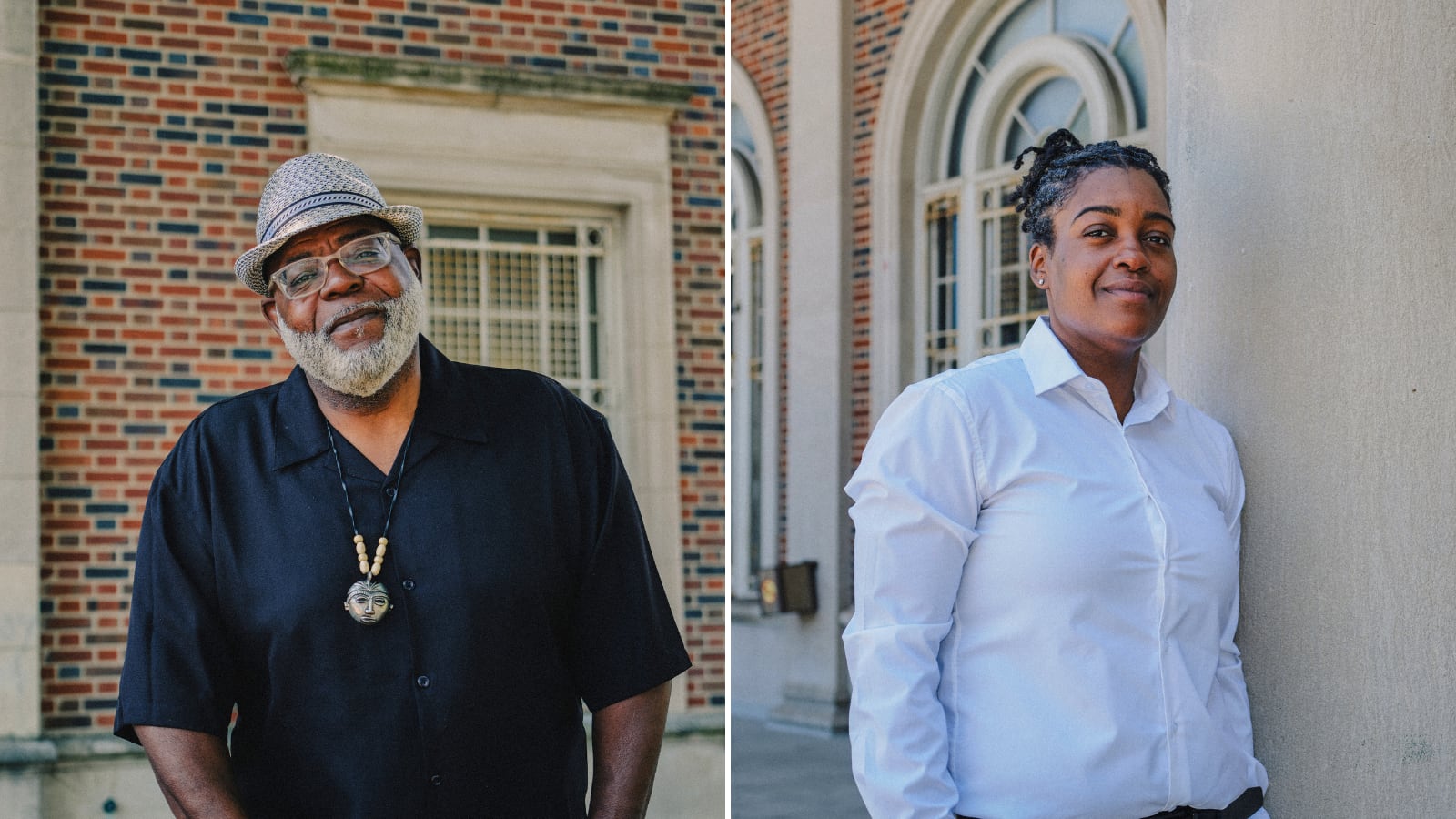
Incumbent Aaron “Jitu” Brown, a veteran community organizer, wants to secure more state funding and trim administrative overhead in Chicago Public Schools. His challenger, LaPamela Williams, an Austin native who attended Lane Tech College Prep, wants to increase financial accountability and cut expenses that aren’t benefiting students. Kernetha Jones, who was removed from the ballot, wants to see test scores improve before putting more money into what she calls a “failed system.”
The district stretches from the majority-Black Austin neighborhood to the west, through sections of Garfield Park and Humboldt Park, ending with Ukrainian Village to the east. The wide swath of the West Side encompasses 39 schools serving mostly Black and Latino students.
Students who live in District 5a are less likely to attend their neighborhood school than students in most other parts of the city, particularly for high school. Less than 7% of high schoolers in this area chose their neighborhood option, according to CPS data. One high school, Frederick Douglass Academy in Austin, had just 27 students last year, and has become a focal point in debates over how CPS should address declining enrollment.
All three candidates live in Austin. Their views diverge when it comes to independently run public charter schools, with Brown and Jones opposing their expansion, while Williams supports opening more if there is community support.
Williams was driven to run for the board by her love for learning and for her community. She was born, raised, and still lives in Austin.
“Education is forever, and the kids in my district are really suffering, especially academically,” Williams said, citing high rates of absenteeism and students graduating without the skills they need to succeed after high school.
Williams is a relative newcomer to education advocacy and organizing. But she said years of experience in customer service roles, including as a nursing home aide, have prepared her.
“Everything about my work is customer satisfaction,” Williams said. “Breaking information down so people can understand it … Actually listening to what people are saying and putting that action into it.”
Williams is backed by the Illinois Network of Charter Schools, which advocates on behalf of charters and has a well-financed political arm, as well as The Urban Center, a centrist political organization that supports charters and advocates for school choice across public and private schools. She is also supported by the Common Ground Collective, a pro-business, anti-CTU political action committee that is heavily funded by billionaire Michael Sacks and says it aims to engage voters around “effective progressive policies.”
She differs from Brown and Jones in her views on charter schools.
Brown believes CPS can take over management of existing charters to prevent harm to students. Jones supports helping existing charters if they are performing well. But neither believes there’s a need for new charter schools.
Williams supports opening new charter schools where there is community need, but only when the groups operating them have sustainable funding and a clear plan to improve learning. Williams also said CPS should do more to support existing charter schools if they are producing results and “meeting the criteria that they should be meeting.”
If elected, Williams said she would take a deep dive into the budget.
“The solution is constantly more taxes, more money,” Williams said. “But we need to be more responsible with the budget and overseeing it and making sure that when you are paying, that people are delivering.”
Read Williams’ full questionnaire.
Brown, who grew up on the city’s Far South Side, played a prominent role in the yearslong fights against school closings in Chicago and for a fully elected school board. Notably, he participated in a hunger strike that helped reopen Dyett High School in Washington Park. Since 2012, he has led a nonprofit that fights charter school expansion and works to support neighborhood schools.
Brown ran unopposed for his seat in 2024. He was endorsed by the CTU and leads the board’s Black Student Achievement Committee, which is working to close racial disparities and improve Black students’ classroom experiences.
“My concern is not just for Black students, but Black students are the population that’s in crisis,” Brown said.
Brown’s work in education stretches back to the 1990s, when his rap group visited a South Side elementary school. Brown remembers a young man sitting slumped in his chair saying, “Man, you cool, but you ain’t coming back.”
“That kind of stuck with me,” Brown said.
After that, Brown started volunteering with kids through the Kenwood Oakland Community Organization. He noticed resource disparities as he worked in different schools and communities.
“These children on 39th Street have one computer in their class, and that’s it,” Brown said. “There’s no Black history being taught to these young people. I realized that there’s an equity issue, and that began my path.”
Brown has been a key voice pushing for more state funding to address the district’s budget gap. He wants state lawmakers to increase taxes for the wealthy and close tax loopholes for corporations.
“The political will is there,” Brown said, to “not only tie a tourniquet” but also “heal the wound.”
Read Brown’s full questionnaire.
Jones grew up on the West Side of Chicago and graduated from Farragut High School.
According to her resume, she taught students with learning and behavioral disabilities in CPS over four school years in the 1980s and ‘90s.
Jones did not respond to requests for an interview, but in our CPS school board questionnaire, she expressed support for school choice and providing parents with vouchers, which are typically used to offset the cost of private school tuition.
Jones opposes the district’s comprehensive sex education and claimed, without evidence, that CPS uses lessons that sexualize children and are pornographic. Two years ago, when Jones made similar claims as a District 5 write-in candidate, Chalkbeat found no evidence that CPS curriculum covers anything of that nature.
In 2024, a Chalkbeat reporter asked Jones, who frequently used anti-transgender language in her 2026 candidate questionnaire, how she planned to represent students of varying gender and sexual identities. At the time, Jones said she isn’t against students who do not identify as heterosexual, but she’s against “grooming them in school without the parents’ knowledge. I’m against you changing the children’s names without the parents permission.”
CPS policy says schools should not share a student’s gender identity without the student’s consent or authorization from the district’s law department. Under the policy, students have the right to be addressed at school by the names and pronouns they choose.
Jones also wants to limit the use of artificial intelligence in classrooms due to the potential for racial bias in AI teaching tools. She wants CPS to hire more Black teachers so Black students see more educators who look like them. Research has found this strategy can foster a sense of belonging and lead to lower suspension rates and higher graduation rates for Black students. In 2025, 34% of CPS students identified as Black, compared with 21% of teachers.
Read Jones’ full questionnaire.
Lisa Kurian Phillip is a higher education reporter for WBEZ Chicago. Contact Lisa at lphilip@wbez.org.