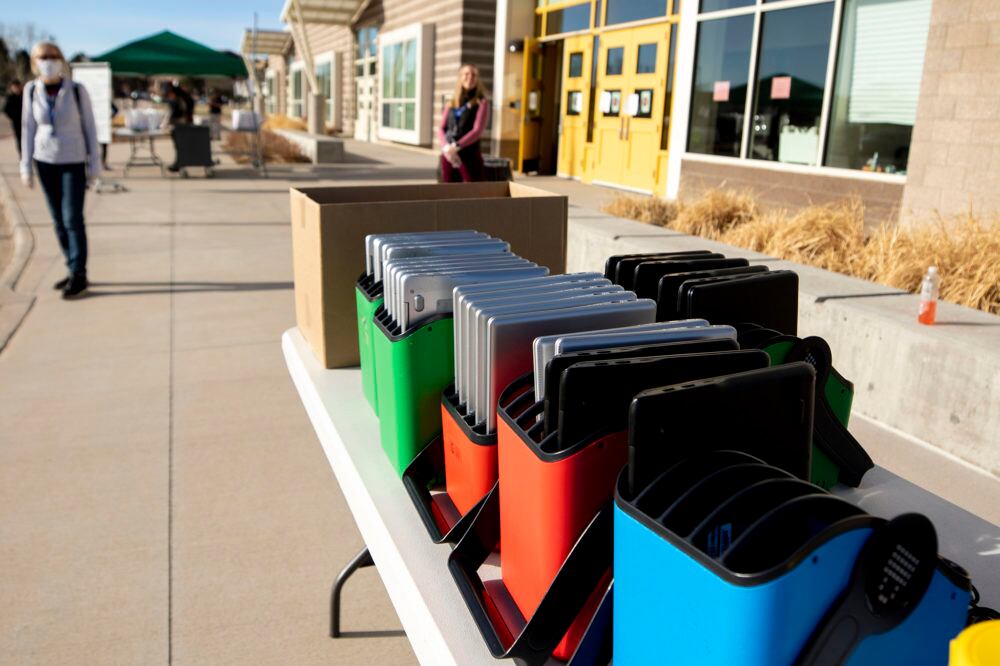
Five days from starting a new school year online, the Denver district has a computer shortage.
Denver Public Schools ordered 12,500 computers but not all of them have arrived, spokesperson Winna MacLaren said. The district serves about 92,000 students. As many as 3,000 students may start the school year without a device, MacLaren said.
District officials on Wednesday cited a nationwide device shortage caused by global supply chain issues. Denver experienced similar shipping delays in the spring, when rising COVID-19 cases caused schools to abruptly shift learning online. Other Colorado districts have also reported long delays in obtaining laptops, with some shipments not expected until 2021.
School is scheduled to start again in Denver on Monday. Classes will be conducted virtually until at least mid-October, when the district will assess whether it’s safe to reopen campuses.
To address the computer shortage, the district is asking that families who already have a personal device at home not request one from their child’s school. Families who have both a personal device and a school-issued device are being asked to return the school-issued device so it can be redistributed to a student who doesn’t have one.
The district is also sharing information about where and how families can purchase a device of their own — more specifically, a Chromebook with at least 4GB of memory.
A district press release on Wednesday contained a link to an organization called PCs for People, which sells low-cost refurbished computers. But on Wednesday evening, the PCs for People website said its laptops were out of stock. “Please check back,” it said.
The district spent about $3 million on devices in the spring and ordered another $5 million worth of devices for this fall, MacLaren said earlier this month. The district has also spent nearly half a million dollars helping about 2,700 households get internet access, MacLaren said.
But an estimated 4% of students — about 3,600 kids — still won’t be connected to the internet when school starts next week, she said. Superintendent Susana Cordova said the district is prioritizing getting devices and internet access to students who are the most in need.