Sign up for Chalkbeat Colorado’s free daily newsletter to get the latest reporting from us, plus curated news from other Colorado outlets, delivered to your inbox.
On the eve of the Nov. 7 election, spending in the Denver school board races has climbed to nearly $1.9 million, according to reports filed with the Colorado Secretary of State’s office.
It’s not a record yet — but it’s close. The most expensive Denver school board race ever was in 2019, when candidates and outside groups spent $2.28 million. However, this year’s running total has surpassed spending in the last election in 2021, which totaled $1.67 million.
Three seats on the seven-member Denver school board are up for grabs Tuesday. The election won’t change the balance of power on the board; members backed by the Denver teachers union will still hold the majority of seats. But it could change the board’s interpersonal dynamics, which have been tense, and perhaps the political dynamics as well.
As in past elections, the bulk of the spending is by independent expenditure committees, which cannot coordinate with the candidates. In Denver Public Schools election politics, the Denver Classroom Teachers Association is typically on one side, and groups that support charter schools and education reform are on the other side.
So far, the pro-charter side is outspending the union 4½ to 1.
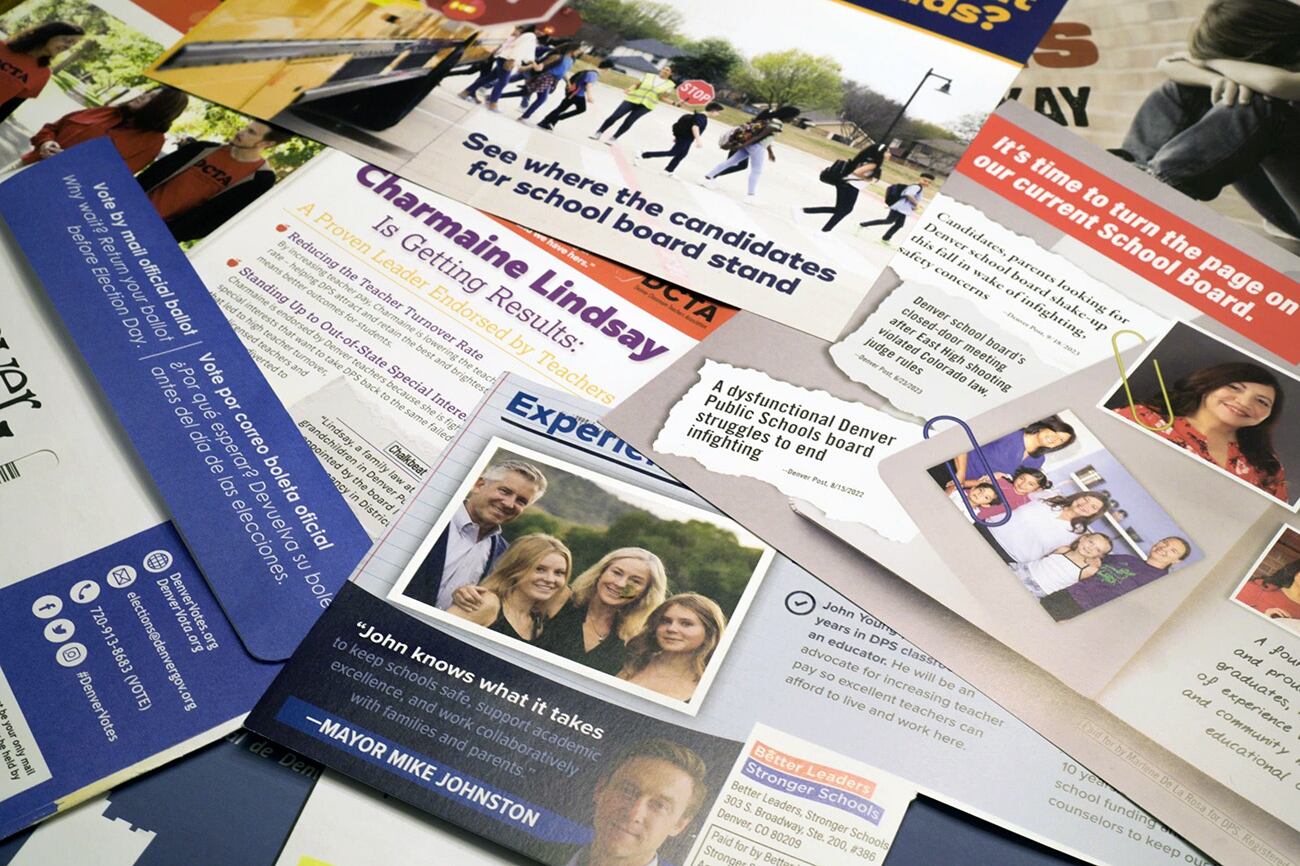
This year’s big spender is a pro-charter committee called Better Leaders, Stronger Schools, which has spent $1.3 million on digital advertising, mailers, text messaging, and even TV ads, which are unheard of in Denver school board elections.
The committee is supporting three candidates: John Youngquist for an at-large seat, Marlene De La Rosa in District 5, and Kimberlee Sia in District 1.
Better Leaders, Stronger Schools is largely funded by Denver Families Action, the political arm of a group called Denver Families for Public Schools. Denver Families was founded in 2021 with the backing of several local charter school networks, and its board is made up of charter leaders.
Better Leaders, Stronger Schools has also gotten donations from wealthy Colorado businesspeople, including $250,000 from Kent Thiry, the former CEO of dialysis provider DaVita. Envision CEO James Rechtin gave $15,000, while SonderMind CEO Mark Frank and Benson Mineral Group Co. each gave $20,000. Oakwood Homes CEO Pat Hamill, Liberty Global CEO Mike Fries, and private-equity firm Rallyday Partners each gave $10,000.
The teachers union is supporting three candidates: Kwame Spearman for the at-large seat, Charmaine Lindsay in District 5, and Scott Baldermann in District 1. Lindsay and Baldermann are incumbents running to keep their seats.
The union is spending money two ways: by giving directly to the candidates and through its own independent expenditure committee. So far, the Denver and Colorado teachers unions have given $47,500 each directly to Spearman and Baldermann, and $35,405 to Lindsay.
The union’s committee, called Students Deserve Better, has spent just over $150,000 on mailers and digital ads in the Denver school board races this year.
For the second time, Baldermann is largely self-funding his campaign, pumping $91,000 into his reelection bid so far. In 2019, he spent more than three times as much.
Melanie Asmar is a senior reporter for Chalkbeat Colorado, covering Denver Public Schools. Contact Melanie at masmar@chalkbeat.org.