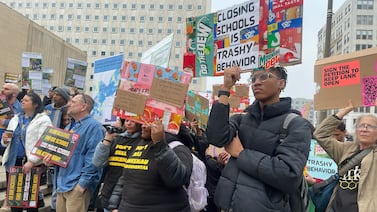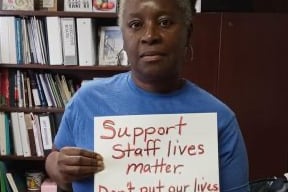
Two unions that represent support staff in the Detroit school district are demanding the option to work remotely during the COVID-19 pandemic.
Their ask comes nearly a week after the school district and the union representing teachers reached an agreement that allows all teachers to choose between in-person or online instruction. The support staff unions want that same flexibility for the school year that begins Tuesday.
“COVID doesn’t discriminate,” said Donna Jackson, president of the Detroit Federation of Paraprofessionals, which represents about 1,200 staffers, including classroom aides and food service workers. “At least give us the opportunity to have a choice.”
District officials say these employees are needed to provide supervision for learning centers that will operate in school buildings. Although 80% of the district’s students are starting the year learning online, the district is opening the learning centers inside schools, where students can complete their online work.
The beginning of the school year has brought with it labor strife across the nation, as teachers and other school employees raise health and safety concerns about returning to school buildings. In Chicago, the Chicago Teachers Union filed a grievance and a lawsuit last week over a school district policy requiring clerks to assist with student registration inside school buildings, without giving the union an opportunity to negotiate working conditions. In New York City, the mayor announced this week that the school year would be delayed 11 days after union leaders warned it wasn’t yet safe to reopen buildings.
Stephanie Carreker, who heads the Detroit Association of Educational Office Employees, said many of the roughly 250 clerical workers the union represents are afraid to continue working in school buildings.
“We have several members with underlying health conditions, are immunocompromised, taking care of elderly parents or taking care of children,” Carreker said.
District superintendent Nikolai Vitti said clerical staff have been required to work in person since June.
“This is not a decision unique to DPSCD. We are not aware of any Wayne County public school district not making the same decision regarding paras and clerical,” he said.
Vitti also said the district is offering all employees working in person during the pandemic hazard pay. The details on the specific amount for those in the paraprofessional and clerical staff unions are being determined as part of current negotiations.
Last week, the district and the Detroit Federation of Teachers, the union that represents over 4,000 employees, many of whom are teachers, reached an agreement over hazard pay, and ensures members have the option to work in person or remotely. That agreement also promises ongoing, voluntary COVID-19 testing for students and staff and the establishment of a joint labor-management safety community to review pandemic health data and make safety recommendations.
However, DFT president Terrence Martin stressed that the union could still institute a “safety strike” if school officials fail to follow these measures. During such a strike, employees would work remotely — not stop work altogether.
As bargaining continues this week, Jackson is frustrated that the work of support staff, essential for keeping schools running, wasn’t getting enough respect even before the pandemic began.
“We are constantly overlooked,” she said. “The work of support staff matters.”