Did you know search engines like Google are changing the way you see news? Keep Chalkbeat’s valuable education coverage at the top of your feeds by clicking here and checking the box next to our name.
Before Bob Behning took the reins of the Indiana House Education Committee, there were no school vouchers in the state. Charter schools were in their nascent stages. And the state had yet to reinvent high school.
After 34 years in the Indiana House, and the last 15 as chair of the education committee, Behning lost reelection last night to Democratic challenger Jarren Hurt, according to unofficial Marion County election results. His shocking ouster — and that of House Speaker Todd Huston and several other Republicans on the committee — throws into question the direction of education policy in the next legislative session and beyond.
Over his tenure, Behning was seen as one of the state’s leading legislative champions of education reform. He authored and sponsored bills that established the Indiana Choice Scholarship, greater flexibility for charter schools, and new grading scales for schools and teachers as part of the broader education agenda of two state leaders, Republican Gov. Mitch Daniels and state Superintendent Tony Bennett.
He built on those changes in recent years with the creation of the Indianapolis Local Education Alliance and its successor, the Indianapolis Public Education Corporation, which lawmakers established to require Indianapolis Public Schools and local charters to share more resources. He also advocated for the expansion of private school choice to all families under the banner of parental rights.
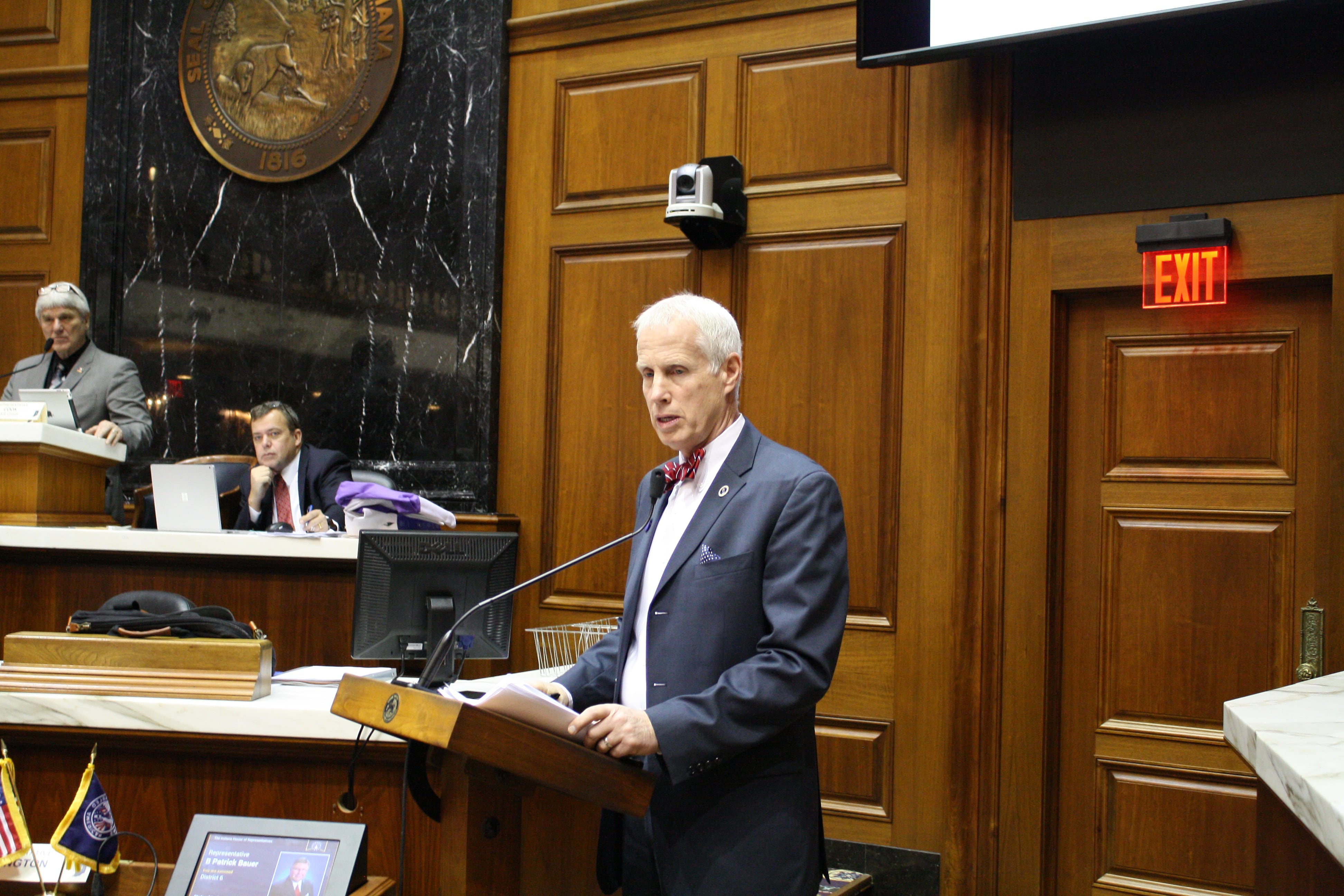
“I think letting parents make that choice as to what’s best for their son or daughter is the best way to move forward,” Behning said at a 2024 legislative conference.
But these moves drew the ire of public education advocates. Cathy Fuentes-Rohwer, president of the Indiana Coalition for Public Education, characterized him as the architect of policies that her coalition has opposed. She said lawmakers should take note of the defeat of Behning and Huston, who also worked for Bennett and served on education committees under Daniels.
“I think there’s a strong message that Hoosiers support their public schools and are tired of the lack of support from the state,” she said.
Behning was in the midst of a multi-year deregulation effort aimed at redundant and outdated language in Indiana education code when he lost his seat on Tuesday.
His office did not respond to an interview request about the election results. A separate attempt to reach Behning was unsuccessful.
Behning’s influence has been monumental, said Betsy Wiley, president and CEO of the Institute for Quality Education, a school choice advocacy organization. While the education reforms of 2011 under Daniels and Bennett set the tone for policies today, Wiley said Behning’s push for early literacy was one of his top achievements.
“There’s no question from an education perspective that we would not be where we are today and we would not have the successes and educational freedom we have today without him,” Wiley said. “If you ask him, he would say none of them are his. He would downplay his own role.”
Indiana House Education Committee loses several GOP members
Of nine Republicans who sat on the House Education committee in 2026, just two have comfortably won reelection this year — Reps. Martin Carbaugh and Zach Payne.
In fact, several of the seats that Indiana Democrats flipped to break the Republican supermajority in the House belonged to education committee members: Andrew Ireland, Becky Cash, Julie McGuire and Hunter Smith.
Rep. Jake Teshka’s race was too close to call Wednesday, while Michelle Davis instead ran for and won a state senate seat.
In recent years, the committee has passed significant changes to Indiana education, such as reinventing high school. They’ve also passed several controversial bills, such as one concerning the display of the Ten Commandments in public schools, which ultimately failed, and a bill to restrict the content of school library shelves, which passed.
Behning himself oversaw the shift in GOP attitudes toward topics like social emotional learning: While he authored a bill providing grants for positive behavioral intervention practices in 2015, Republican lawmakers took aim at those and other social emotional learning requirements in 2025.
Education was not necessarily a central issue in this year’s election, which was primarily about President Donald Trump, said Christopher Lubienski, professor of education policy and director of the Center for Evaluation and Education Policy at Indiana University
Still, the outcome could have repercussions for Indiana, which has tried to keep up with a cadre of states like Texas and Arizona when it comes to education policy.
“The nature of the conversation will be qualitatively different,” Lubienski said. “There will be new ears. I’m not sure if the policies will change.”
What will immediately change is the makeup of the House Education Committee, said one of its members, Democratic Rep. Ed DeLaney of Indianapolis. For one thing, Democrats will likely gain seats on the committee.
DeLaney also said he believes newly elected representatives better understand the issues facing schools, and will oppose recently adopted initiatives that favored charter schools and established Swiss-inspired job training programs.
“It’s not a coincidence that these people lost. They became, in my view, too arrogant, too unaware of public education problems — declining enrollment, restrictions on property tax funding,” he said. “We operated on slogans not on policy. The slogan era is over now.”
Aleksandra Appleton covers Indiana education policy and writes about K-12 schools across the state. Contact her at aappleton@chalkbeat.org.